
The Most Expensive Dysfunction in B2B Product Companies
And How To Force the Work Back Into Connection With Reality

Someone recently said something to me that I haven’t been able to shake. We were talking about a product team (a good one, by most measures) that had been heads-down building for months. They were shipping features, clearing the backlog, hitting their sprint goals. And yet the business wasn’t moving. Worse, the team didn’t realize that without that connection, the business would eventually stop scaling.
The phrase they used was:
“We have to force the work back into connection with reality.”
I love this phrase because of the word “force.” Not “nudge.” Not “align.” Force. It implies that the natural state of product work is disconnected from reality, that the drift happens on its own, and reconnecting requires deliberate, sometimes uncomfortable effort. And honestly? That tracks with everything I’ve seen over ~25 years of building software.
I’ve been writing about this problem, from different angles, for years now. So I want to use this post to pull those threads together into a single argument, because the phrase captures a pattern I keep coming back to: the gap between what product teams do and what the business needs is the single most expensive dysfunction in B2B product companies. If you’re new here, this is a crash course. If you’ve been around a while, it’s a reminder of why this stuff matters so much.
What Disconnection Looks Like
Let’s start at the top. During my job search last year, I had a conversation with a CEO who described their last head of product as “the worst kind of nothing, an expensive nothing.” That phrase hit hard, and it wasn’t an isolated sentiment. I kept hearing variations of it across multiple CEO conversations: an impatience with how long it takes product leaders to create impact, a growing belief that the function hasn’t delivered ROI.
I wrote about this in The Unimpactful PM, and the pattern I kept seeing was structural: there are fundamentally 3 assets within a product company:
product vision
R&D resources
the P&L statement
And you need to control at least one to have any shot at impact. Most product leaders who are deemed unimpactful never got the ability to pull any of these levers. The work was disconnected from reality not because the people were bad, but because the scaffolding for impact didn’t exist.
But even when the structural conditions are right, the drift still happens. It usually starts with teams losing their sense of direction.
Why Teams Drift
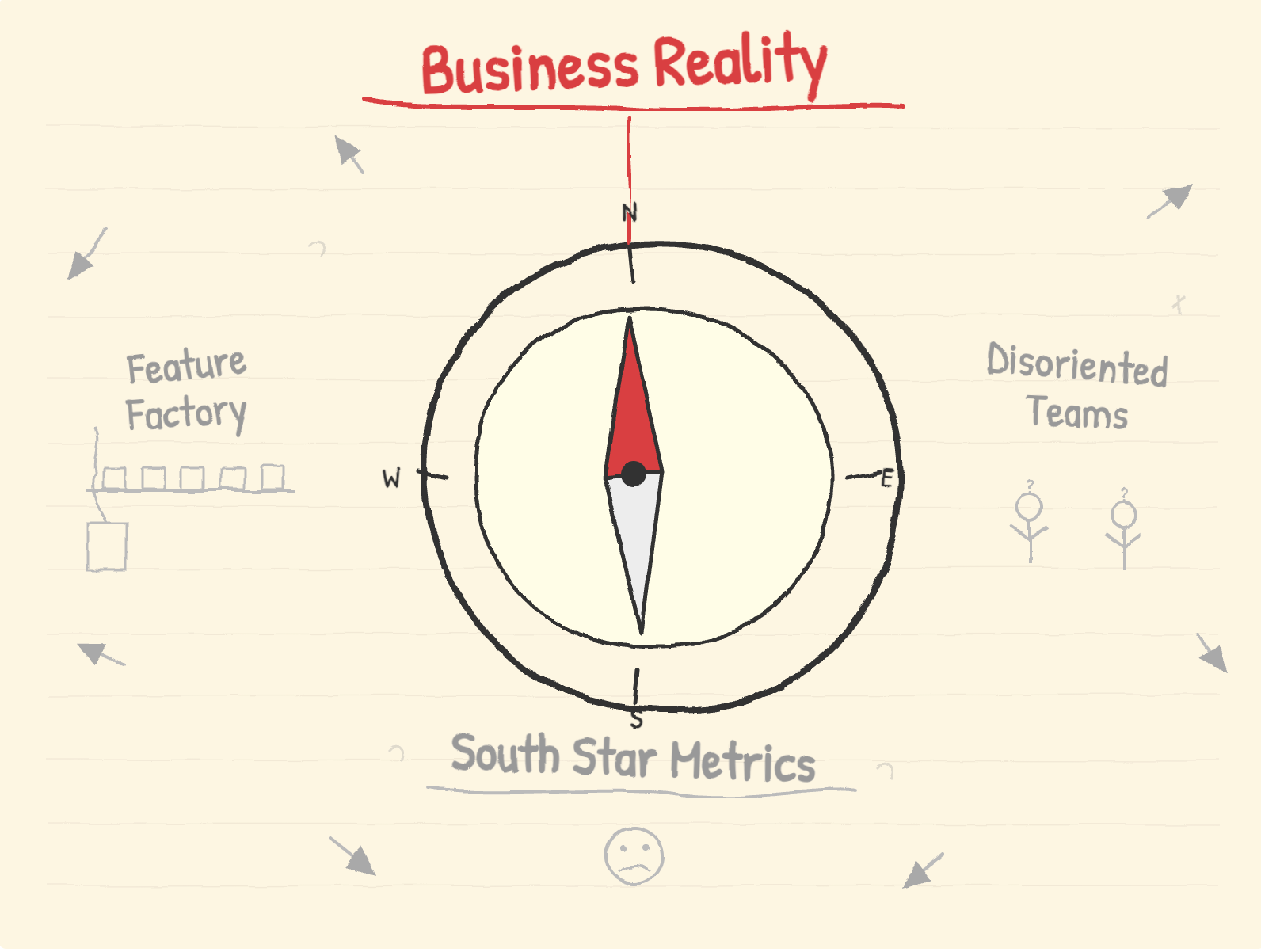
I picked up a piece of trivia from a podcast a while back: the word “orientation” comes from The Orient (the East). In olden times, when a traveler was lost, they situated themselves by confirming they knew which way east was. To be “oriented” means to know where you are relative to your ultimate goal. I wrote a short post about this called Disoriented Teams, and the core observation was this: as leaders, we spend enormous energy trying to make oriented teams more effective (better metrics reviews, tighter execution, faster cycles). But we underinvest in the lower-hanging fruit: getting disoriented teams re-oriented. A disoriented team isn’t just underperforming - it’s creating drag on the entire org.
So what keeps teams oriented? Strategy. But not just any strategy. A coherent one. After the Disoriented Teams post, a reader asked me: “are there systematic practices to prevent disoriented teams in the first place?” That question led to Staying Synced on Strategy, where I laid out 4 dimensions of strategic coherence:
legibility - is it clearly written and digestible?
synchronicity - does the org design align with it?
composability - is the sequencing logical?
affordability - does the org have the stomach to actually execute it?
When one or more of these dimensions breaks down, incoherence follows. And incoherence is really just another word for “the work is no longer connected to reality.”
But even with a coherent strategy, teams can still slide into disconnection. And the mechanism for that slide is what I think of as the “reptilian brain” problem.
The Reptilian Brain Problem
No product team starts as a feature factory. Most viable products begin with a real customer problem and a differentiated insight that lets them get traction. But somewhere along the way, the higher-brain functions get overwhelmed and everybody falls back on their lizard brain. I explored this in Falling into a Feature Factory, where I traced how the drift happens through a thousand small surrenders to urgency rather than one big strategic failure.
For managers, it’s time pressure that flips the switch. Executive reviews that need status updates, investor decks that need meaningful progress, contract renewals that need upsell features, press cycles that need announcements. When you live quarter to quarter and move from firedrill to firedrill, your reptilian brain becomes your best survival mechanism. Decision makers multiply, decision criteria become fluid, and the best-informed employees (the ones who actually understand the problem space) feel the most sidelined.
For makers (PMs, designers, engineers), the temptation is to just accept the reactive mode. But just because the roadmap is snapshotted quarterly doesn’t mean you can’t plan multi-quarter bets. Just because executives want impact articulated as revenue doesn’t mean revenue has to be your north star. Just because sales is fixated on the next launch doesn’t mean you can’t educate them on the value that already exists (I wrote about this in Buried Treasure, where the greatest hits are often hiding in the long-tail catalog). Controlling the lizard brain is a choice, and it’s one that separates the PMs who grow into leaders from those who stay in reactive mode forever.
When Even the Metric Lies
Here’s where it gets really insidious. Sometimes the “connection to reality” exists on paper. You have a north star metric. The team is aligned. The dashboards are green. And yet the metric itself is pulling you in the wrong direction.
I call this a South Star Metric. My favorite example: a Microsoft PM I interviewed years ago who had been on the Windows Update team. Their goal was to get 90%+ of machines on the latest OS version. The number had been stuck at 80% no matter what they tried. So they just... stopped asking. Forced updates without user consent. I nearly fell out of my chair. Here was one of the masterminds behind the most annoying productivity killer in corporate history, the dreaded mid-sentence reboot. When I asked how the team reconciled the experience trade-off, the response was: “well, the metric.”
South. Star. Metric. The team was connected to a number, but that number was disconnected from customer value and business health. This is one of the subtlest forms of the problem, because everyone thinks the work is connected to reality. The dashboards say so. But the reality the metric reflects and the reality the business needs to navigate are two different things.
The Mechanism for Reconnecting
So what does “forcing the connection” actually look like in practice? Over the years, I’ve landed on a framework I keep coming back to. At the highest level, a B2B business can be broken down into 3 KPIs:
growth (revenue generation)
retention (revenue preservation)
margins (revenue sustainability)
I first wrote about this in Connecting B2B Products to Revenue and expanded on it in From Daily Decisions to Bottom Line. If you want a practical workshop on applying this, I also recorded a 60 Minute Stories video session where I walk through the framework live and do real-time metric laddering during a Q&A with ~500 PMs.
The mechanism is a 3-tier ladder. At the top: business KPIs that executives and investors care about, but these are lagging indicators, hard to directly move. In the middle: strategic levers that create leverage to move those KPIs, which ideally serve as the pillars of your R&D and GTM investment. At the bottom: north star metrics that teams own and drive, which are leading indicators they can actually use for prioritization and trade-off decisions.
No matter what your product team’s north star is, this framework can be used to connect the dots from top to bottom. The one instance where it doesn’t work at all is a disjointed company, where product value has no correlation to business value. And that brings us full circle: if your strategy is incoherent, your teams are disoriented, and your metrics are pointing south, then this ladder has nothing to stand on. You have to fix the foundation first.
The most common anti-patterns I see are:
treating revenue as the direct metric a product team is accountable for (it’s a lagging indicator, not a north star)
trying to show a single hop between feature development and revenue generation (it’s always more than one hop)
letting “orphan” teams persist, teams that don’t tie to any strategic lever or business outcome but continue to exist as investments because nobody has the courage to redirect them
If any of these sound familiar, the ladder is broken somewhere, and that’s where to start digging.
What Connection Actually Looks Like
When you get it right, when the work is truly connected to business reality, what does it look like?
I think it looks like manufacturing champions: the idea that every B2B product team’s job, at its core, is to create users who are so successful with your product that they become your advocates. When R&D is building toward manufacturing champions and GTM is selling and servicing toward manufacturing champions, the work is connected. Not to an abstract metric, not to a quarterly target, but to a real, tangible outcome that both sides can see and feel.
This is the endgame. Not perfect metric alignment. Not flawless strategy execution. The endgame is a shared, operational understanding of what success looks like in the customer’s world, and the discipline to keep pulling the work back toward that understanding every time it drifts.
The Drift Is the Default
If there’s one thing I want you to take away from this, it’s that the word “force” matters. The reconnection never happens naturally. Gravity pulls teams toward disconnection: toward comfortable metrics, toward reactive modes, toward doing the next thing on the list without asking whether the list is connected to anything that matters.
Teams will lose their orientation. Managers will fall into reptilian mode. Metrics will point south. The laddering will get fuzzy. Champions will become an afterthought. And when that happens, someone has to look around and say…
“we have to force the work back into connection with reality.”
That someone, more often than not, is you.
If you’d like to go deeper on any of these ideas, you can continue the conversation with my digital clone / second brain LemonAid. Here are some prompts to try:
“What are the 3 assets a product leader needs to control for impact, and how do I assess whether I have them in my current role?”
“My team seems disoriented. How do I diagnose which of the 4 dimensions of strategic coherence is breaking down?”
“What are the signs that my product org is falling into feature factory mode, and what’s the first thing I should do about it?”
“How do I tell if my north star metric is actually a south star metric?”
“Help me build a metric ladder connecting my team’s work to business KPIs for a B2B product focused on retention.”
“What does manufacturing champions look like in practice for a product team that sells to enterprise buyers?”
As always, I’d love to hear about your own experiences with this disconnect, and what it took to force the reconnection. Drop a comment below👇 or join the chat via the Substack app.

And if you enjoyed this post, please share / subscribe.
further reading / references
The Unimpactful PM - what happens when product leaders can’t pull the levers that matter?
Disoriented Teams - a short piece on teams that don’t know which way is east
Staying Synced on Strategy - the 4 dimensions of strategic coherence
Falling into a Feature Factory - the causes of reptilian product development
South Star Metrics - when your north star is actually sending you the wrong way
Connecting B2B Products to Revenue - the laddering framework for tying product work to business KPIs
From Daily Decisions to Bottom Line - operationalizing the revenue connection, with best practices and anti-patterns
Manufacturing Champions Part 1 & Part 2 - the shared north star that connects R&D and GTM
Death & Taxes in B2B - the cost trade-offs between pitched product vision and realized customer value
childish drawing / interpretation
I've noticed all of the traits of disorientation in all my product teams. It's draining and bosses have a cognitive dissonance when they complain about the lack of trust with Sales while I point out that the product strategy has no connection with the sales strategy whatsoever.